De Laval Nozzle Optimization & Thrust Analysis
Investigating how exit cone geometry (\(10^{\circ}\) to \(30^{\circ}\)) influences supersonic exhaust efficiency.
Overview
ROLE: Lead Developer
Back in 2022, as a 10th-grade researcher, I designed and executed a study to analyze how the exit angle of a de Laval nozzle affects the conversion of thermal energy into kinetic thrust. This project required building a custom thrust-testing stand from scratch and developing an Arduino logic to bridge the gap between theoretical fluid dynamics and empirical data.
Methodology & Testing Hardware
- Numerical Baseline: Used the Rocket Thrust Equation to fix nozzle top area (25x throat width) and entrance angles at \(30^{\circ}\) to isolate the exit angle as the independent variable.
- Static Fire Test Stand: Constructed a cube-shaped aluminum frame housing a 20kg Load Cell sensor and HX711 amplifier.
- Propellant Synthesis: Formulated KNSB fuel (65% Potassium Nitrate, 35% Sucrose) and utilized specialized cellophane molds to ensure consistent grain geometry.
- Data Capture: Built an Arduino-based data logger that sampled thrust values every 0.1 seconds, recording over 200 data points per static fire.
Engineering Log: Fabrication & Testing
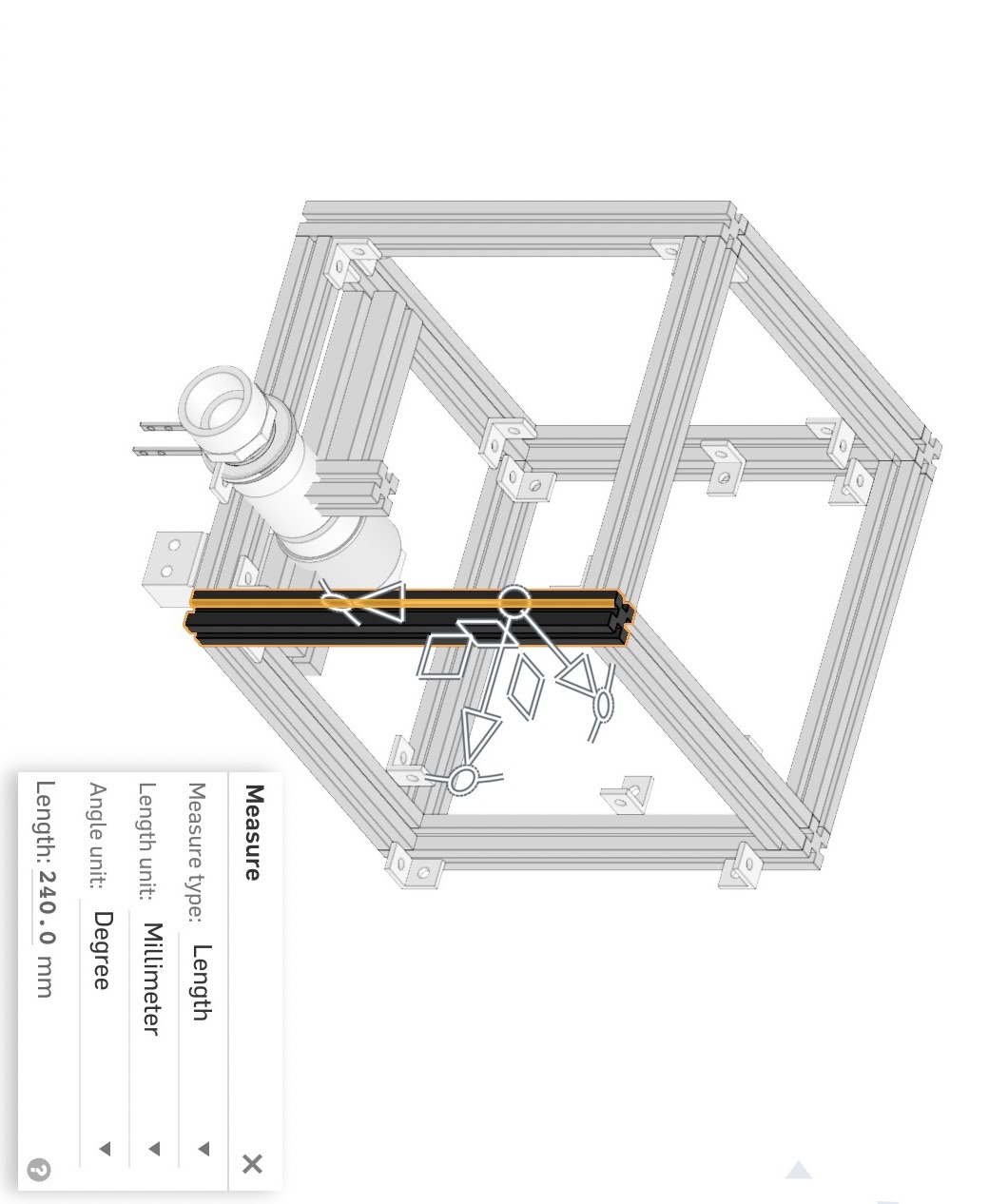
Structural Design: CAD modeling of the 240mm aluminum profile test stand, ensuring precise alignment for vertical thrust vectoring and stable load cell readings.
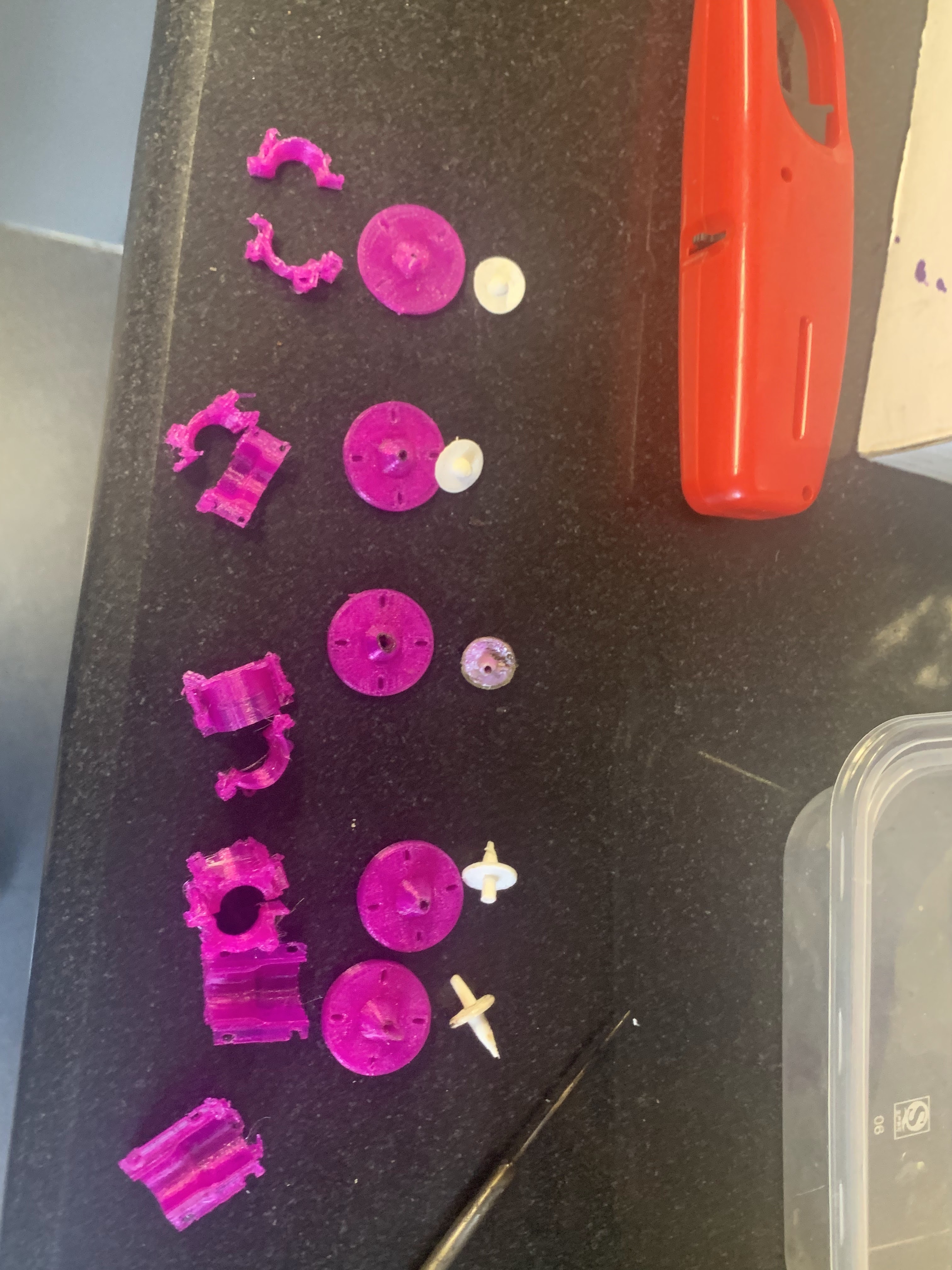
Rapid Prototyping: 3D-printed PLA molds used for casting the final cement-based de Laval nozzles to withstand combustion temperatures.
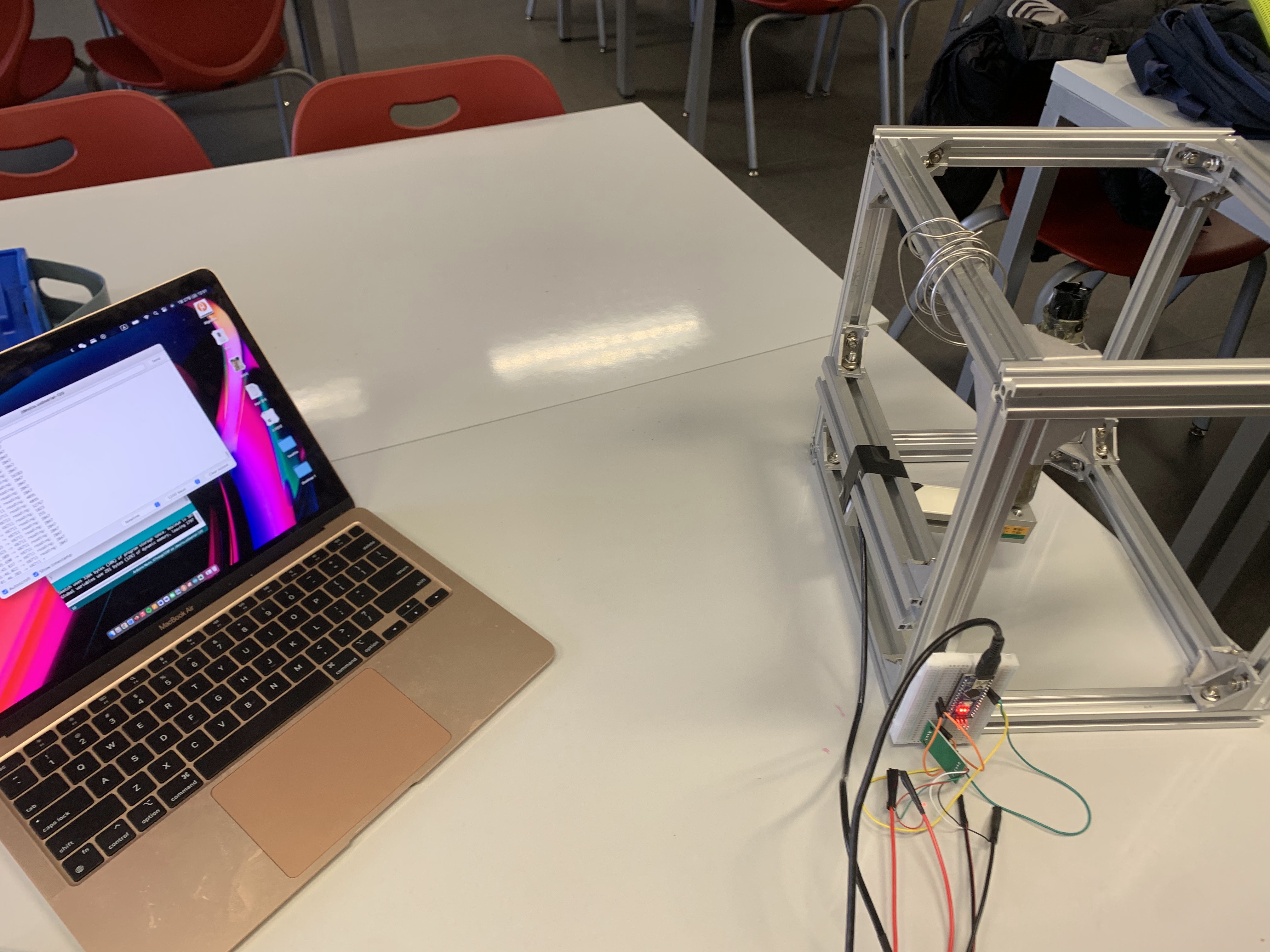
Data Acquisition (DAQ): Integrating an Arduino Nano with the HX711 amplifier to log real-time force data at 10Hz frequency.

Combustion Chamber: A high-temperature boiling tube mounted with nichrome wire, containing 20g of solidified KNSB propellant.
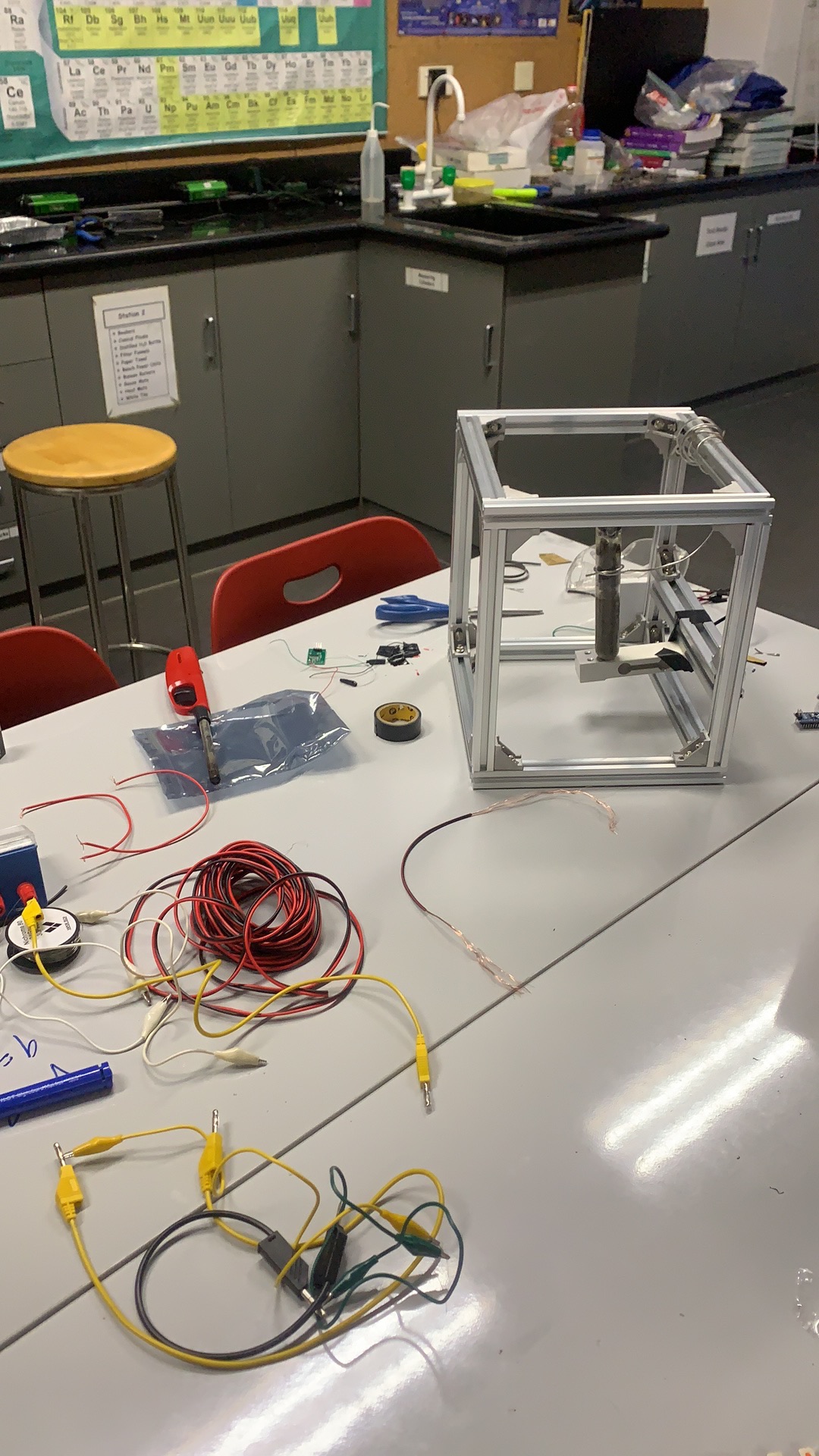
Static Fire Operations: The final integrated assembly at the lab bench prior to ignition for independent thrust variable testing. The attempt of failed nichrome wire E-match can be noticed.
Technical Struggles & Engineering Mitigations
1. High-Temperature Material Failure
Initial tests used PLA 3D-printed nozzles which would deform under the heat of KNSB combustion.
Mitigation: Used 3D-printed designs only as molds for cement-cast nozzles. This allowed for the complex internal geometry of a de Laval nozzle while providing the necessary thermal resistance.
2. Numerical Precision & Latency
The initial Arudio and Load Cell setup suffered from signal noise and measurement latency, making it difficult to capture the exact peak of the thrust curve.
Mitigation: Implemented Standard Deviation analysis to quantify "radicalness" (combustion intensity) and used a line of best fit to determine a correlation coefficient of $-0.98$ for thrust efficiency.
3. Ignition & Initial Launch
The primary electronic ignition system (E-Match) failed to initiate the KNSB grain despite a nominal 27V power supply. The root cause is currently unidentified; potential factors include thermal dissipation limits or chemical compatibility between the E-Match pyrogen and the propellant binder.
Mitigation: To bypass the electrical failure, a secondary powder train composed of crushed KNSB was manually established. This allowed for thermal propagation into the combustion chamber via the nozzle throat. Designing a remote-triggered ignition system with onboard telemetry to isolate electrical impedance vs. chemical initiation failure would be helpful to identify the source of failure.
Reflections & Modern Re-Analysis
- Historical Context: This is the first project that I started from scratch. This project taught me that engineering is a compromise between parameters like weight, mechanical strength, and performance.
- The Lesson of 15°: My results corroborated professional findings that exit angles near \(15^{\circ}\) optimize the conversion of subsonic to supersonic flow while minimizing turbulence.
- Current Goal: Previously, I only processed data with medium values and line of best fit. I am currently re-processing this 2022 dataset using Savitzky-Golay Filter to replace the original linear approximations. Version 2026 coming up soon!
- Growth: Moving from 10th-grade "basic" Excel data processing to my current work at USC RPL reflects a shift from empirical "guessing" to high-fidelity numerical simulation.